If you’d like a proper assessment instead of more guesswork:
📞 Call us on 01234 353 937
🌐 Or visitbedford-chiropractor.co.ukto book your £49 consultation.
Take the first step – your future self will be glad you did.

When you ask:
“How many sessions will I need to get better?”
you’re not asking out of curiosity.
You’re really asking:
All absolutely fair.
The stock answer you often hear is:
“It depends.”
And sure, it doesdepend… but that’s not helpful on its own.
So in this blog, I’m going to give you the version I’d give a mate over a coffee:
What to say so you stay in control

You’re investing:
You’re not being rude if you want to know:
Any chiropractor who can’t have that conversation calmly is missing the point.
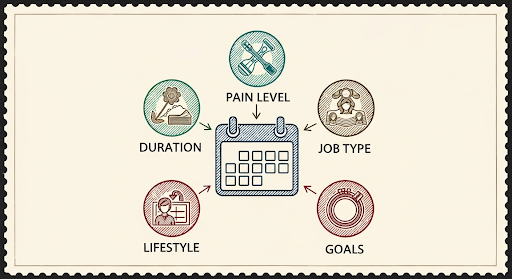
Now, here’s the honest bit: there really isn’t a one-size-fits-all number. It depends on:
So yes – it does depend.
But that doesn’t mean we can’t talk in realistic ranges and phases, so you know what’s going on.
Instead of thinking “forever” vs “one miracle session”, it’s much more useful to think in three phases:
This is when you first arrive:
Here the goal is simple:
Reduce pain and get basic life back: sitting, walking, sleeping, moving without wincing.
In this phase, you’ll usually see:
By the end of this relief phase, we should be asking:
If the answer is yes, clearly– we’re heading in the right direction.
If the answer is basically no changeafter a fair trial, the answer is not“just keep going indefinitely.” It’s:
“We need to re-check the diagnosis, adjust the plan, or involve someone else.”

Once the worst has calmed down, the conversation changes.
Now we’re asking:
“How do we make you tougher, stronger, and more resilient so this doesn’tflare every time life gets busy?”
In this phase we focus more on:
What this usually looks like:
This is where the balance shifts from:
“What happens toyou on the table”
to:
“What you do with your body in between visits.”
By the end of rebuild:
You’re no longer dependent on constant treatment just to cope.

This is the part people argue about.
Short answer:
No, you do nothave to keep going forever.
Maintenance or performance care is completely optional.
Maintenance care just means:
For some people that’s:
For others, it’s:
Both are valid.
Maintenance should feel like:
“This helps me stay on top of things and it’s worth it to me.”
not:
“I’ve been told my spine will collapse if I ever stop.”

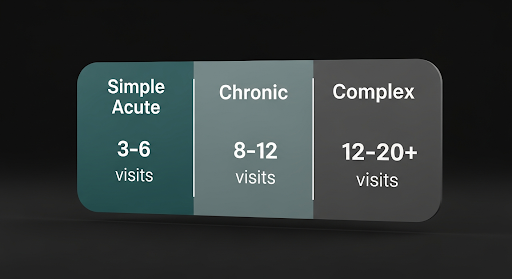
Let’s put some honest, ballpark numbers down. These aren’t rules – just realistic ranges so you’re not in the dark.
Example:
Common pattern:
If you’re 6–8 sessions in with no noticeable change, the plan needs re-thinking.
Different story:
Here, a realistic first block is often:
Some people will need fewer, some more, but as a starting structure, that’s sensible. It gives us enough time to see real change, not just a one-off good day.
If things are clearly better – we taper.
If things are only slightly better – we tweak the plan.
If there’s no meaningful change – we reconsider the diagnosis and maybe bring in other professionals.
Think:
These often need:
You might be looking at:
Total: easily 12–20+ visitsspread over a few months.
The key thing isn’t the exact number – it’s that it’s:
Always open to changeif it’s not working for you
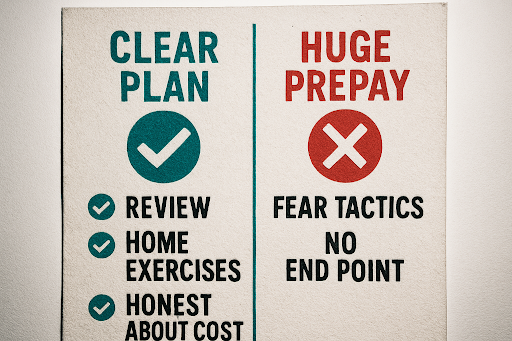
This is where people sometimes get burned, so let’s be very direct.
A good chiropractor might recommendongoing care, but they should be able to explain:
Let’s clear a few things up.
If you like scripts, steal these.
You’re not asking for a guarantee, just an honest estimate.
A good answer sounds like:
“Based on what I’m seeing, I’d expect somewhere around X–Y visits over the next few weeks. We’ll review at [time] and adjust up or down based on your progress.”
You’re both anchoring to outcomes, not just attendance.
You might hear:
Good responses:
You want to hear:
You’re allowed to plan and budget.
Any professional should be able to ballpark that with you.
If your spine were truly “out of place” in the dramatic way some diagrams show, you’d likely be in an emergency department, not a clinic.
We’re dealing with:
Not dislocated vertebrae floating around your body.
You’ll see claims online that adjustments:
The reality:
Most evidence-based chiropractors today focus on musculoskeletal and neuromusculoskeletal problems– where the science is strongest.
Chiropractic is part of the team, not a rival.
The best results often come when:
Different tools. Same goal: get you functioning and feeling better.

If you said to me:
“Just be straight – how many sessions am I realistically looking at?”
I’d say:
The exactnumber isn’t the real issue.
The real questions are:
You are not signing up for treatment till the end of time.
You’re starting a plan with:
…and from there, any ongoing care is your decision, not a sentence.
If you’re living with back pain, neck tension, sciatica, headaches or just feel your body isn’t moving the way it should, you don’t have to put up with it or try to guess what’s wrong.
At Bedford Chiropractic Clinic, we offer a £49 new patient consultationwhere we:
Explain clearly what we’ve found and what your options are
If you’d like a proper assessment instead of more guesswork:
📞 Call us on 01234 353 937
🌐 Or visitbedford-chiropractor.co.ukto book your £49 consultation.
Take the first step – your future self will be glad you did.
Monday
9:00 AM - 7:00 PM
Tuesday
2:00 PM - 7:00 PM
Wednesday
9:00 AM - 7:00 PM
Thursday
CLOSED
Friday
10:00 AM - 4:00 PM
Saturday
FOR EMERGENCY ONLY
Sunday
Closed
@ 2025 Bedford Chiropractic Clinic
how many chiropractor sessions do i need, how much chiropractic, how many chiro sessions do i need, how many chiropractic sessions do i need
When considering chiropractic care, many patients wonder about the typical duration of treatment and how it correlates with their specific conditions. Understanding the phases of care can help set realistic expectations. Each phase—relief, rebuild, and maintenance—has its own timeline and goals, which ultimately guide the number of sessions required for effective treatment.
For example, patients experiencing acute pain may find relief within a few weeks, while those with chronic issues might require a longer commitment. By clearly defining these phases, patients can better appreciate the journey of recovery and feel more empowered in their treatment decisions.
Different conditions respond uniquely to chiropractic care, which influences the treatment plan and duration. For instance, neck pain may resolve more quickly than chronic lower back pain, which often requires a more extensive treatment protocol. Understanding these distinctions helps patients anticipate their care journey based on their specific diagnosis.
Additionally, conditions such as sciatica or migraines may necessitate a tailored approach, addressing not only the symptoms but also the underlying causes. This specificity in treatment ensures that patients receive the most effective care for their individual needs.
Active participation in the treatment process is crucial for successful chiropractic care. Patients are encouraged to communicate openly with their chiropractor about their progress, concerns, and lifestyle factors that may affect their recovery. This collaborative approach fosters a sense of ownership over one’s health journey.
Moreover, incorporating exercises and lifestyle adjustments as part of the treatment plan can significantly enhance outcomes. By understanding their role in the recovery process, patients can feel more confident and engaged in their chiropractic care.
After completing a course of chiropractic treatment, many patients wonder what to expect in terms of ongoing care and management of their condition. While some may feel fully recovered, others might benefit from periodic check-ins to maintain their progress and prevent future issues.
It’s essential for patients to discuss their long-term goals with their chiropractor. This conversation can help establish a plan that includes follow-up visits or self-care strategies, ensuring that patients remain proactive about their spinal health and overall well-being.
how many chiropractor sessions do i need, how much chiropractic, how many chiro sessions do i need, how many chiropractic sessions do i need
When considering chiropractic care, many patients wonder about the typical duration of treatment and how it correlates with their specific conditions. Understanding the phases of care can help set realistic expectations. Each phase—relief, rebuild, and maintenance—has its own timeline and goals, which ultimately guide the number of sessions required for effective treatment.
For example, patients experiencing acute pain may find relief within a few weeks, while those with chronic issues might require a longer commitment. By clearly defining these phases, patients can better appreciate the journey of recovery and feel more empowered in their treatment decisions.
Different conditions respond uniquely to chiropractic care, which influences the treatment plan and duration. For instance, neck pain may resolve more quickly than chronic lower back pain, which often requires a more extensive treatment protocol. Understanding these distinctions helps patients anticipate their care journey based on their specific diagnosis.
Additionally, conditions such as sciatica or migraines may necessitate a tailored approach, addressing not only the symptoms but also the underlying causes. This specificity in treatment ensures that patients receive the most effective care for their individual needs.
Active participation in the treatment process is crucial for successful chiropractic care. Patients are encouraged to communicate openly with their chiropractor about their progress, concerns, and lifestyle factors that may affect their recovery. This collaborative approach fosters a sense of ownership over one’s health journey.
Moreover, incorporating exercises and lifestyle adjustments as part of the treatment plan can significantly enhance outcomes. By understanding their role in the recovery process, patients can feel more confident and engaged in their chiropractic care.
After completing a course of chiropractic treatment, many patients wonder what to expect in terms of ongoing care and management of their condition. While some may feel fully recovered, others might benefit from periodic check-ins to maintain their progress and prevent future issues.
It’s essential for patients to discuss their long-term goals with their chiropractor. This conversation can help establish a plan that includes follow-up visits or self-care strategies, ensuring that patients remain proactive about their spinal health and overall well-being.