Is Chiropractic Care Safe – And Can It Cause a Stroke?

Let’s be honest

You’ve probably heard someone say:

“Be careful – once you start going to a chiropractor, you have to keep going forever…”

It’s usually said with that I-know-something-you-don’t tone, like chiropractic is a subscription you can never cancel.

So when you ask:

“If I start, do I have to keep going forever?”

what you’re really asking is:

  • “Is this going to be honest healthcare or a long-term sales hook?”
  • “Will I lose control once I’m on the table?”
  • “Can I just have a short, focused plan and then be done?”

Let’s answer this like we’re sat in the clinic, no white coat, just straight talk.

1. Two very different things people mix up

A lot of the “forever” fear comes from mixing up two completely different stages of care:

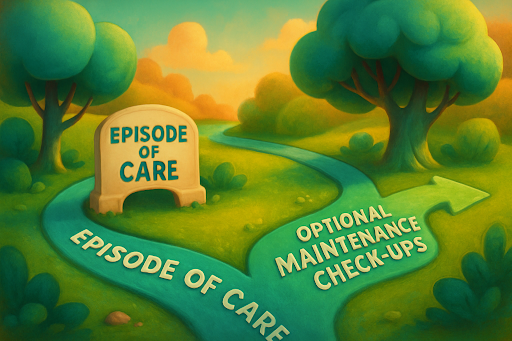
  1. Treatment for a current problem
  2. Ongoing check-ups or maintenance care

If you lump them together, it sounds like an endless tunnel. But they’re not the same.

1. Treatment for a current problem

This is when you’re in pain now:

  • Low back spasm, sciatica, neck pain, headaches, shoulder or hip problems.
  • Your function is affected – sitting, standing, lifting, sleeping, working.

Here the plan should be:

Time-limited, goal-based care designed to get you from “I’m struggling” to “I can manage this.”

You should expect:

  • A proper history and exam
  • A working diagnosis
  • A plan that says:

    • How often you’ll be seen (for now)
    • What you’re trying to change (pain, movement, function)
    • When you’ll be reviewed

Guidelines for low back pain – like NICE in the UK and international low back pain guidelines – recommend non-surgical, conservative treatments such as exercise and manual therapy (including spinal manipulation) for defined episodes of back pain or sciatica, not open-ended care with no review.

So the “treatment” phase is meant to have a beginning, middle and end.

2. Maintenance / wellness / performance care

This is:

  • After your main symptoms are under control.
  • You’re functioning reasonably well.
  • You’ve noticed that occasional care – plus your own exercises – helps to keep flare-ups down or performance up.

Now the goal is not “rescue” but maintenance or optimisation, a bit like:

  • Dental check-ups
  • Sports massage
  • Car servicing
  • Regular coaching sessions

Some people use chiropractic this way; others don’t. It’s a choice, not a sentence.

2. What do guidelines and standards actually say about “going forever”?

Let’s park opinions and look at what guidance says.

Low back pain guidelines

NICE and recent international low back pain guidelines say:

  • For low back pain with or without sciatica, consider:
    • Exercise (group or individual)
    • Education and staying active
    • Manual therapy (spinal manipulation, mobilisation, soft tissue work)
  • BUT manual therapy should be:
    • Used as part of a package with exercise and self-management
    • Focused on a specific episode or flare-up

Nothing in these guidelines says:

“Once you start manual therapy, you must carry on forever.”

Quite the opposite – they emphasise:

  • Shorter episodes of care
  • Clear goals
  • Active self-management
  • Review and modification if you’re not improving

Chiropractic-specific quality standards (UK context)

The Royal College of Chiropractors’ quality standard for low back pain (with or without sciatica) says:

  • A plan of care should include objectives, interventions and treatment dose (number and frequency of appointments).
  • Patients should be reassessed if they deteriorate or don’t show significant improvement within about six weeks.
  • Once signs and symptoms are absent, patients are discharged from acute care, usually within four weeks of resolution.
  • After that, ongoing supportive self-management, rehabilitation and prophylactic care may be offered for patients whose condition is manageable or resolved.

In other words:

  • The problem-focused phase ends.
  • Then ongoing care is an option, centred on prevention and self-management, not something you’re forced into.

So both guidelines and chiropractic standards back up this basic message:

Care for a problem should be time-limited, reviewed, and usually discharged.
Ongoing or maintenance care is an optional strategy, not a default obligation.

3. So what is maintenance care – and does it actually do anything?

Let’s define it clearly:

Maintenance care: planned, less-frequent visits after an episode has improved, aimed at preventing flare-ups or reducing their impact, especially in people with recurrent or persistent low back pain.

This isn’t just a tradition – it’s actually been studied.

The Nordic Maintenance Care trials

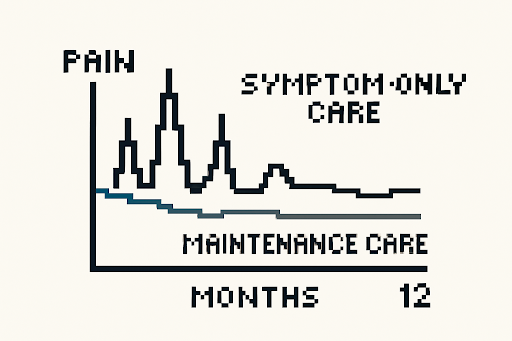
The Nordic Maintenance Care Program looked at people with recurrent or persistent non-specific low back pain under chiropractic care. After an initial improvement phase, they were randomised to either:

  • Maintenance care – regular pre-planned visits, regardless of whether pain had flared yet
  • Symptom-guided care – come back only when pain flared

What did they find?

  • Over 12 months, the maintenance group had fewer days with bothersome low back pain than the symptom-guided group – one analysis found about 12–13 fewer days of bothersome pain per year on average.
  • Maintenance care seemed particularly helpful for a subgroup with more complex or “dysfunctional” back pain patterns.

So broadly:

For people with recurrent or chronic low back pain, a pre-planned maintenance schedule can reduce the total number of painful days and make pain more stable across the year.

Important nuance:

  • It’s not curing the underlying condition.
  • It’s managing a recurring problem more smoothly.

For some people, that trade-off is worth it – fewer bad days, more predictability.

For others, it’s not – they’d rather just come when it flares, or they don’t find the difference big enough to justify the time or cost.

4. Does this mean you should be on maintenance care?

Not necessarily.

It comes down to your pattern and your priorities.

Maintenance care might make sense if:

  • You’ve had recurrent low back or neck pain for years.
  • You work a physically demanding job (builders, nurses, carers, drivers, factory workers).
  • Or you have a high-stress, high-sitting job and your neck/back pays the price.
  • You’ve learned that:
    • Without regular support, pain and stiffness build until you’re in trouble again.
    • With occasional care plus your own exercises, flare-ups are less frequent and less severe.
  • You understand the evidence: it’s about fewer bad days and better management, not a miracle cure.

In that situation, maintenance can be a strategy, just like:

  • Training regularly instead of only when you feel unfit.
  • Getting your car serviced rather than waiting for the engine light to flash.

Maintenance care probably doesn’t make sense if:

  • This is your first ever flare, and it’s mild and clearly settling.
  • You bounce back fully with a short, focused episode of care and good self-management.
  • You don’t have a history of recurrent episodes.
  • You’re very physically active and happy managing things with exercise alone.

And it definitely doesn’t make sense if:

  • You haven’t even improved yet, but you’re already being pushed into a big long-term package.
  • The conversation is driven by fear (“if you stop, your spine will collapse”) rather than realistic pros and cons.

5. Red flags: when “going forever” really is a problem

Here’s where I’m just going to be blunt.

If you see these patterns, your “forever” alarm is allowed to go off.

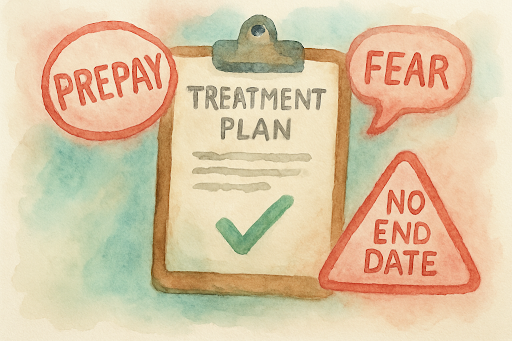
1. Big pre-paid packages before any real assessment

If, before anyone has:

  • Taken a proper history
  • Examined you
  • Explained what they think is going on

…you’re being sold a long course (e.g. 40–70 visits prepaid):

  • That’s a sales script, not patient-centred care.
  • You cannot tailor a year-long plan to a person you haven’t yet examined.

A sensible clinician might say, after assessment:

“Given your history and goals, I’d expect roughly X visits over Y weeks.
We’ll review at this point and adjust.”

Not:

“Here’s the 12-month package everyone buys.”

2. Fear-based language

If you hear things like:

  • “If you stop care, your spine will degenerate quickly.”
  • “Your nervous system will shut down if you don’t keep being adjusted.”
  • “You’ll definitely get serious disease if you don’t maintain care.”

…that’s not education. That’s fear marketing.

Clear, honest education sounds more like:

“Because your pain is recurrent, regular care might reduce the number of bad days you have.
It’s not compulsory – it’s one option. Let’s talk about whether that fits your life, budget and goals.”

3. No review points, no discharge, no talk of self-management

If your plan is essentially:

“Just keep coming twice a week indefinitely…”

with no mention of:

  • Re-assessment
  • Outcome measures
  • Tapering frequency
  • Discharge
  • Exercises, lifestyle changes and self-management

…then you’re not really in modern, guideline-backed care.

High-quality standards emphasise:

  • Shared decision-making about goals
  • Treatment dose (how many, how often) agreed together
  • Discharge from acute care once symptoms are resolved
  • Self-management and rehab as the long-term backbone

4. Being discouraged from seeing your GP or other professionals

If anyone tells you:

  • “You don’t need your GP or any tests – only chiropractic can fix this.”
  • “Don’t listen to your consultant / physio / other practitioners.”

…that’s a problem.

A good chiropractor should be comfortable working alongside:

  • GPs
  • Physios
  • Pain clinics
  • Surgeons when appropriate

If anything, they should be the one to say:

“I think we should involve your GP / consider imaging / get another opinion too.”

6. How to keep control of your care (without being awkward)

You don’t need to be confrontational. Just ask good, calm questions.

Here are some phrases you can copy-paste into your life.

At the start

“Based on my case, roughly how long do you expect this first phase of care to last?”
“How many visits are typical for someone like me before you review?”

You’re looking for:

  • A finite episode (e.g. “2×/week for 3–4 weeks, then review”)
  • Not vague infinity.

When you’re improving

“What are the signs that I’m ready to start tapering visits?”
“What needs to be in place before we say I’m done with this episode?”

You’re asking for:

  • Concrete criteria: pain level, function, confidence, self-management.

When maintenance is suggested

“Can you explain the pros and cons of maintenance care in my situation?”
“What happens if I choose not to do maintenance care?”

Good answer sounds like:

“Without maintenance, you may have more flare-ups – but you’ll always have your exercises and can come back if it kicks off. With maintenance, some people find fewer bad days. It’s your call.”

No guilt. No doom.

Around money and time

“If things go as you expect, what’s the likely total time and cost of my care over the next 2–3 months?”

You’re allowed to plan your life.

If someone can’t even attempt to answer that, it’s a bit like a builder refusing to estimate how long or how much a job might be.

7. The honest bottom line

If we strip the emotion and rumours out of it, here’s the simple truth:

  • Starting chiropractic care does not automatically lock you into treatment for life.
  • For a specific problem or flare-up, your care should be time-limited, goal-focused and regularly reviewed, with a clear exit route once you’re better.
  • Maintenance care is a tool – mainly for people with recurrent or persistent issues – that has some evidence behind it for reducing total days of low back pain when used sensibly and by choice.
  • It’s optional. It should be offered, explained and decided with you, not for you.
  • Any model based on fear, huge up-front contracts, or no clear end points deserves serious questioning.

Think of it like this:

Chiropractic isn’t Netflix.
You’re not signing up to “forever”.
You’re starting a piece of care that should have a start, a middle, and an end –
and if you choose to keep it in your life after that, it’s because it’s helping you, not because you’re stuck.

Need help with your pain right now?

If you’re living with back pain, neck tension, sciatica, headaches or just feel your body isn’t moving the way it should, you don’t have to put up with it or try to guess what’s wrong.

At Bedford Chiropractic Clinic, we offer a £49 new patient consultation where we:

  • Listen to your story
  • Examine your spine, joints and nervous system
  • Explain clearly what we’ve found and what your options are
OPENING HOURS

Monday

9:00 AM - 7:00 PM

Tuesday

2:00 PM - 7:00 PM

Wednesday

9:00 AM - 7:00 PM

Thursday

CLOSED

Friday

10:00 AM - 4:00 PM

Saturday

FOR EMERGENCY ONLY

Sunday

Closed

@ 2025 Bedford Chiropractic Clinic

Bedford Chiropractor Clinic